Data Fabric
The memory and context layer powering Guardian Agent to protect coding agents, prevent risk before code exists, and AutoFix the backlog while reducing token costs.
AI alone does not secure your agentic development. Memory and context do.
Coding agents re-ask the same questions on every task. Apiiro Data Fabric answers once, updated with every commit, and enables deterministic security.
Agentic Development
1 | Trust boundaries 2 | Authn / authz 3 | Data access 4 | Input validation 5 | Sensitive data 6 | Output encoding 7 | Secrets 8 | Dependencies 9 | Security controls 10 | Existing vulns
With Data Fabric
Token cost per task
Agents interrogate every repo, directly
Every agent re-interrogates every repo on every task. Cost compounds with developers × prompts × features.
Deterministic security. Lower token costs.
Without Data Fabric
Agents query Data Fabric. It answers from the graph, not the repos.
Asked once, cached deterministically, served to every agent. Cost collapses to the delta that changed.
What makes it unique?
Data Fabric is the memory layer for your evolving software and risk. It maps architecture from code to runtime and connects it to business impact. This customer-specific context protects coding agents, prevents risk, and AutoFixes what matters.
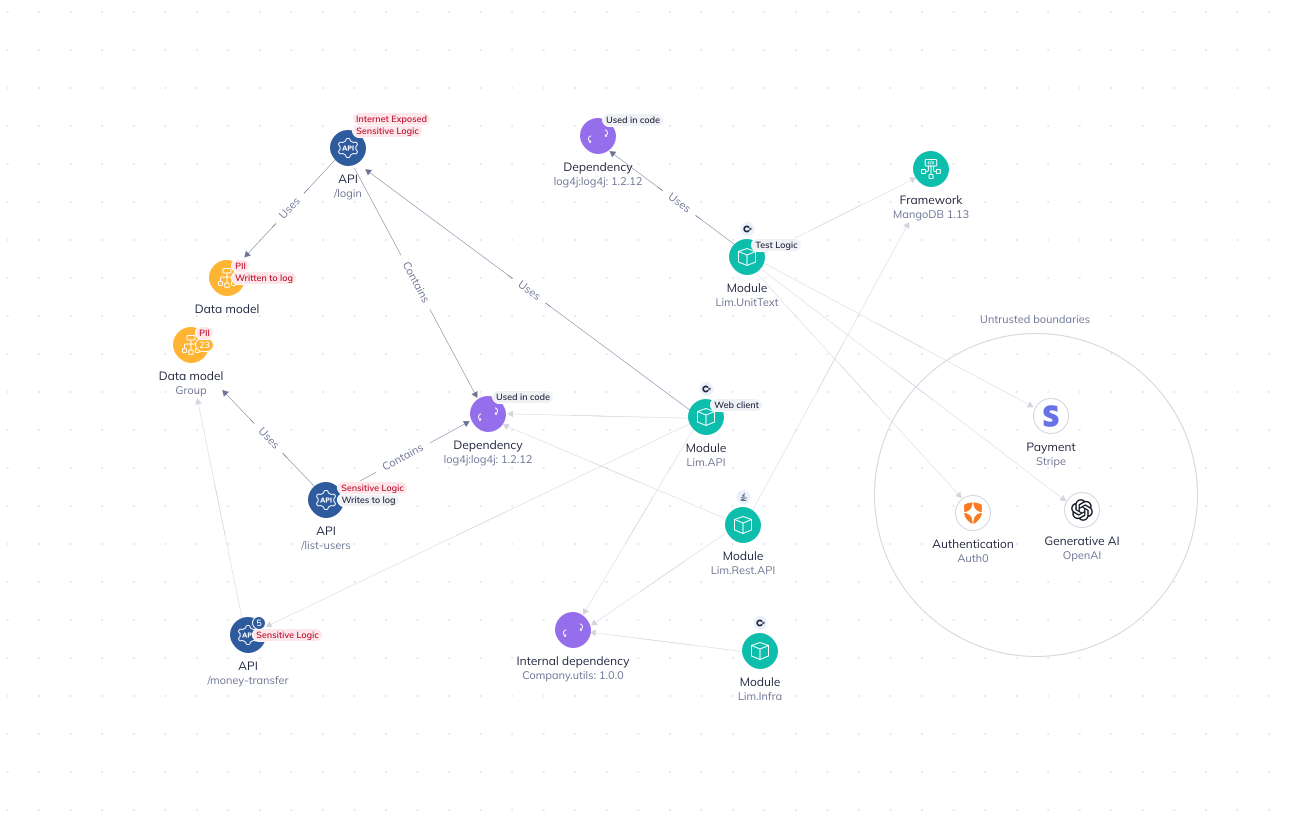
Software Graph
Patented Deep Code Analysis (DCA) and code-to-runtime matching continuously map each customer’s evolving software architecture, from code to runtime, including APIs, AI assets, PII, OSS, internal packages, and their material changes.
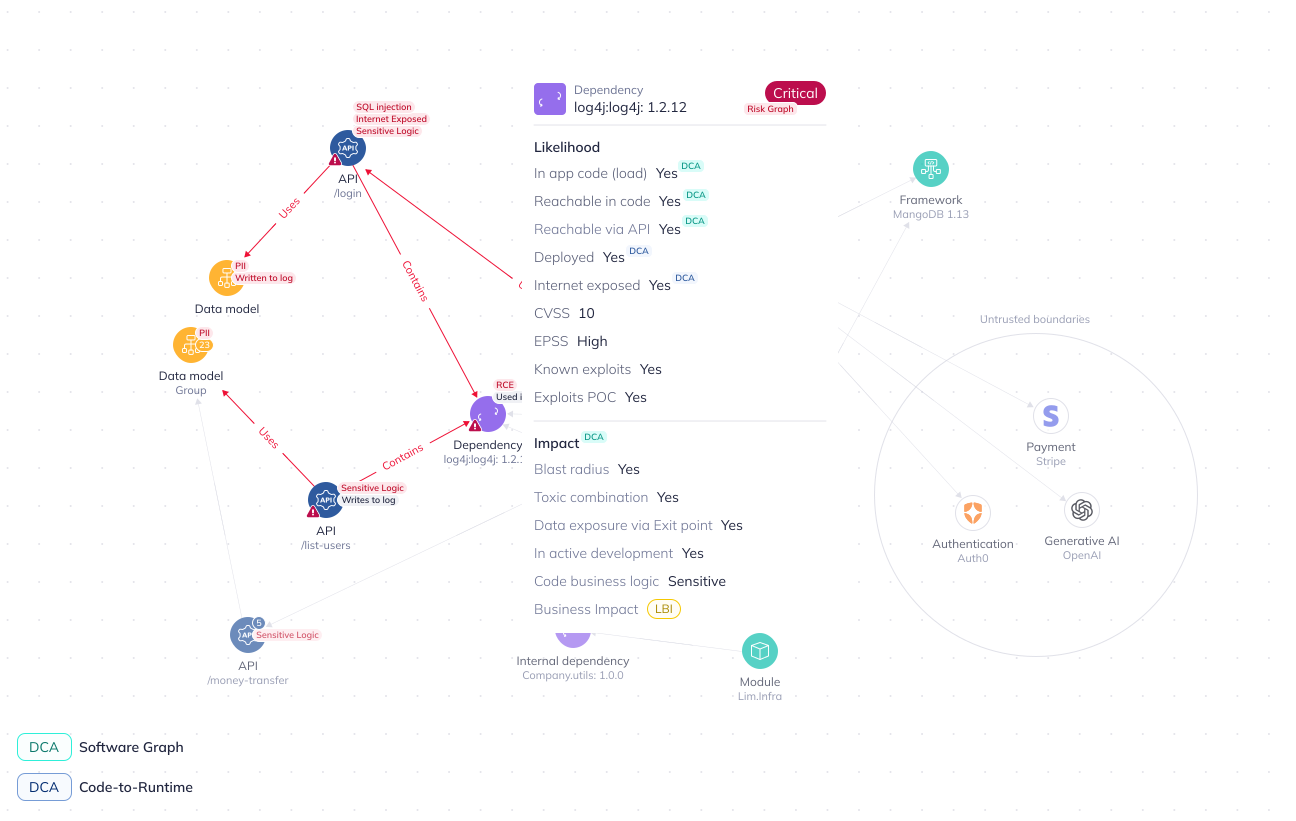
Risk Graph
An open, graph-based risk engine ingests, correlates, deduplicates, and contextualizes signals from 1st and 3rd-party tools, then overlays them on the customer’s software graph to assess, prioritize and fix business-specific risks using built-in or custom policies.
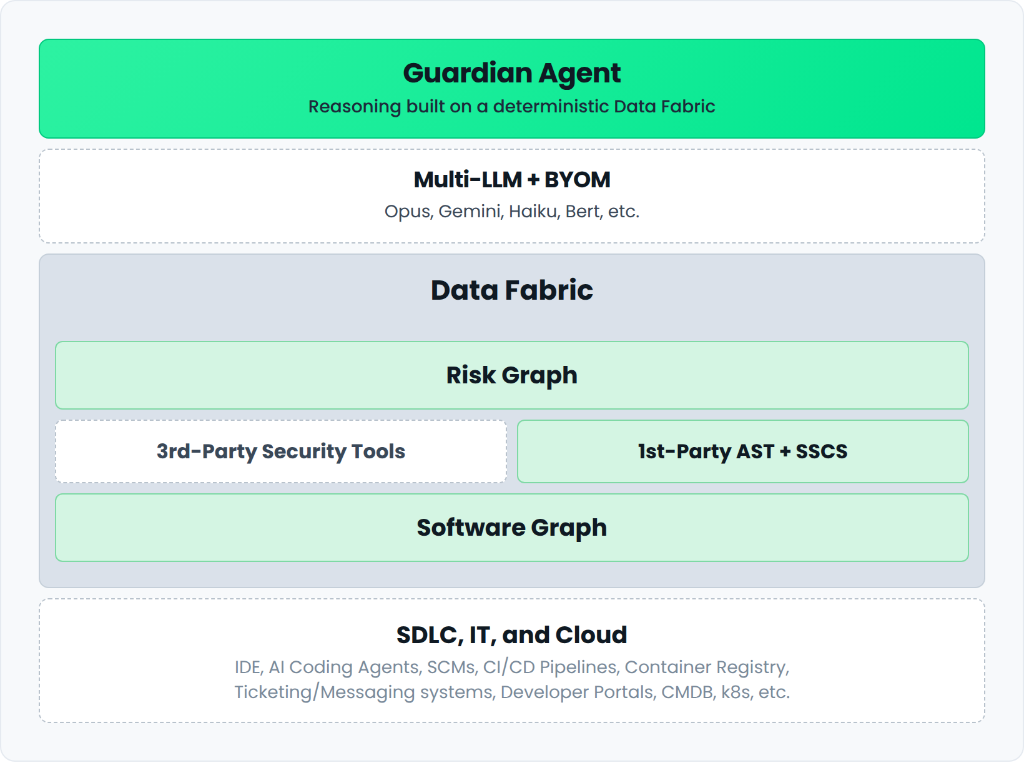
Architecture
Logical Building Blocks
Guardian Agent architecture
What is the AppSec Data Fabric?
Your software architecture changes every time a coding agent ships code. The Data Fabric is the model that keeps up. It combines two connected graphs. Software Graph maps every repo, service, package, API, data flow, and identity edge into one connected model of what the system actually is. Risk Graph maps current risk posture onto it: compliance requirements, policies, trust boundaries, exposure, vulnerabilities, blast radius. Together they form a single authoritative source of truth for the current state of your software architecture from code to runtime, continuously maintained as agents and humans mutate it.
Why can't coding agents secure the features they build?
Agents ship vulnerabilities because working code looks finished - just like it does to humans. The happy path produces a passing feature without ever forcing a security question, so nothing in the immediate feedback loop surfaces the risk. Worse, an agent sees only its own diff. It cannot see the cumulative drift from every other agent and human touching the estate, so it cannot threat-model against a software architecture it cannot see the current shape of. Data Fabric supplies that current shape. The agent queries it instead of guessing - aligning every coding agent across the organization to generate secure artifacts from secure intent, with greater accuracy and significantly lower cost.
Why doesn't per-repo scanning work anymore?
Blast radius does not respect repository boundaries. A flawed auth library, a poisoned internal package, a shared schema, a service contract: the reachable surface runs across code modules and repos through dependency edges, API calls, shared data stores, and identity flows. Per-repo scanners see one repo's diff at a time. They cannot see the edges between repos, which is exactly where cross-repo risk lives. The unit of analysis can no longer be the repository. It has to be an organization-wide software graph that evolves every minute and is continuously enriched with risk context - and that is the Apiiro Data Fabric.
How does it stay accurate when agents are rewriting the codebase continuously?
An agent’s cached security context goes stale the moment the next agent ships. A trust boundary established three features ago may already be wrong. Data Fabric solves this by treating every material change as a delta against a maintained graph, not as a full rescan. That shift - from “re-model everything” to “model the change and its blast radius” - makes per-feature threat modeling, prevention, and AutoFix tractable, predictable, and reliable at agentic development speed, while dramatically reducing token costs.
How does this scale to hundreds or even hundreds of thousands of repositories?
At 500 to 100,000 repos, you do not maintain hundreds or thousands of separate models. You maintain one. Data Fabric stitches every repo, API, service, open source dependency, internal package, data model, data flow, and identity edge into a single organization-wide software graph. A change in one repo becomes a delta against that global model, and its blast radius is computed by traversing the edges that cross into every other repo it can reach. Without one connected model, cross-repo blast radius is uncomputable: you cannot traverse edges you never recorded. At this scale, the graph is not a preference. It is the only architecture left standing.