Digital Infrastructure Leader Scales Small Development Team with Apiiro
Code-to-Runtime + Deep Code Analysis = More fixes, fewer alerts.
Case Study
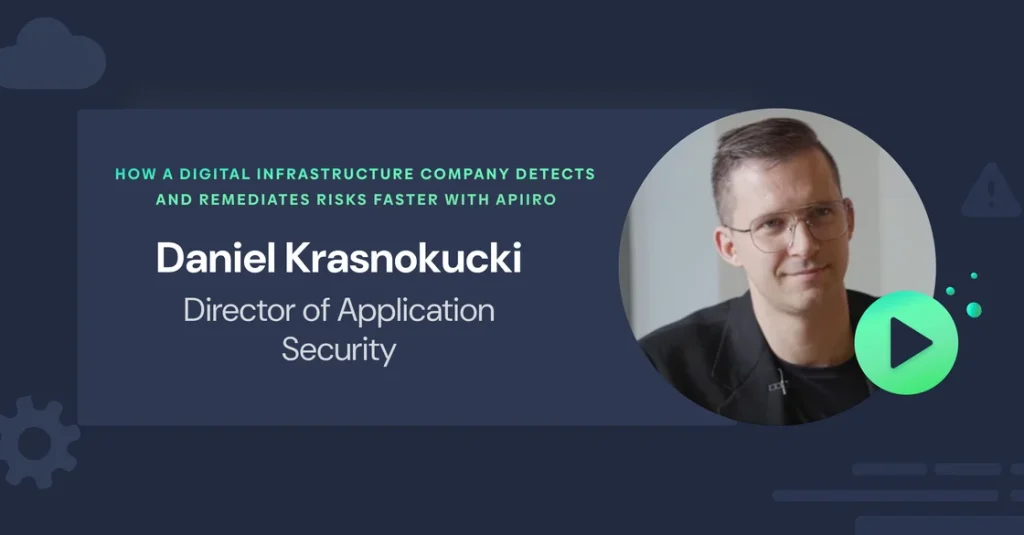
[[youtube:3P5Oivbi3ug]] **KPI** - 1500+ Developers - 35 AppSec Experts - 1 Unified Dashboard – More Alerts Fixed than Alerts Detected in 2024 We sat down with Director of Application Security Daniel Krasnokucki, who built from scratch a team dedicated to securing application architecture for a development community 1500 strong at a leading digital infrastructure provider. Here are the highlights: **Q: What do you expect from a top-performing ASPM?** **A:** Daniel and his team needed an application security posture management solution that could… - Monitor not only scanning tools, but workflow management and ticketing systems to detect and analyze what developers were planning. - Be predictive. Prioritize not only what is in code today, but what will be in code tomorrow (or 6 months from now). - Provide full dashboard customization options, including advanced filtering and timelines. **Q: What impact has your ASPM had on your team?** **A:** A small team with big results. - For the past year, the team has met their goal to fix more vulnerabilities than they have detected. - The ability to tie code to tickets in Jira allows the team to view commits and code evolution in a single, unified timeline via the Apiiro dashboard. - More confident answers to security review questionnaires, and more advanced threat modeling based on the Apiiro feedback loop. **Q: How does code-to-runtime align with your needs?** **A:** One unified timeline for tracking the origin of vulnerabilities. - An automated solution for mapping, tagging, and labeling vulnerabilities - Developers can focus on what matters most – fixing the most critical risks in a timely manner, and getting back to feature work. **Q: How does code-to-runtime reduce your team's MTTR?** **A:** "Because developers know what to fix, it's much easier to see results in minutes or hours rather than days or weeks." - Less dwell time, better results – a remediation graph that shows a decrease in the amount of time between detection and remediation in product.