


Cookies Notice
This site uses cookies to deliver services and to analyze traffic.
📣 Introducing AI Threat Modeling: Preventing Risks Before Code Exists


 Back
Back

Unified risk and vulnerability management across application, infrastructure, and code quality scanners, with code-to-runtime actionable context

Automated security controls validation and assurance based on your organization’s SDLC policies, with actionable context from your CMDB

Risk Graph policy engine and developer’s guardrails at every phase: design, development (pull request), and delivery (build/deploy)
Back


Apiiro started by building our foundational pillars for delivering secure, compliant code – Deep Code Analysis (DCA) and the Software and Risk Graphs™. These enabled us to move security processes from reactive to proactive. From intermittent to continuous. With this Apiiro Data Fabric in place, we went AI-native; embedding AI in our core technology and user experience.
We launched the Apiiro AutoFix Agent in Oct 2025. As we worked alongside our design partners we validated our core thesis: AI needs a map. Context is the critical ingredient for effective application security. We applied the power of the Apiiro Data Fabric – linking code architecture, data flows, and runtime mappings – to provide accurate, effective fixes for real world production risks.
But as AI-driven development accelerates, we came to a realization: remediation alone is no longer sufficient. AI-assisted coding and vibe coding are driving an unprecedented expansion of the attack surface, rendering reactive scanning and fixing loops obsolete.
To stay ahead, application security must evolve further – from Detection to Prevention.
AI coding agents like GitHub Copilot and Cursor have boosted the speed and efficiency of software delivery. However, this speed comes with a tradeoff.
The current cycle of application security is fundamentally reactive: Code is written → code is scanned for risks and vulnerabilities→ code is (auto-)fixed. This creates a “backlog debt” that grows faster than any team can manage. Furthermore, existing tools lack critical context when suggesting fixes – they can read code, but they can’t guess the intent of the developers. This leads to a flood of false positives and developer friction, and a big challenge: How to keep scaling development at the speed of AI, without sacrificing security.
Our answer: Secure-by-Design from the first keystroke.
We must create secure, compliant code from the second it is written – before the first commit – ensuring it is free from vulnerabilities, and aligned with both general secure coding practices, and organization-specific risk policies.
Today, we are thrilled to announce our solution for AI-Native, 0-Vuln, Fully Compliant Code: Apiiro Guardian Agent.
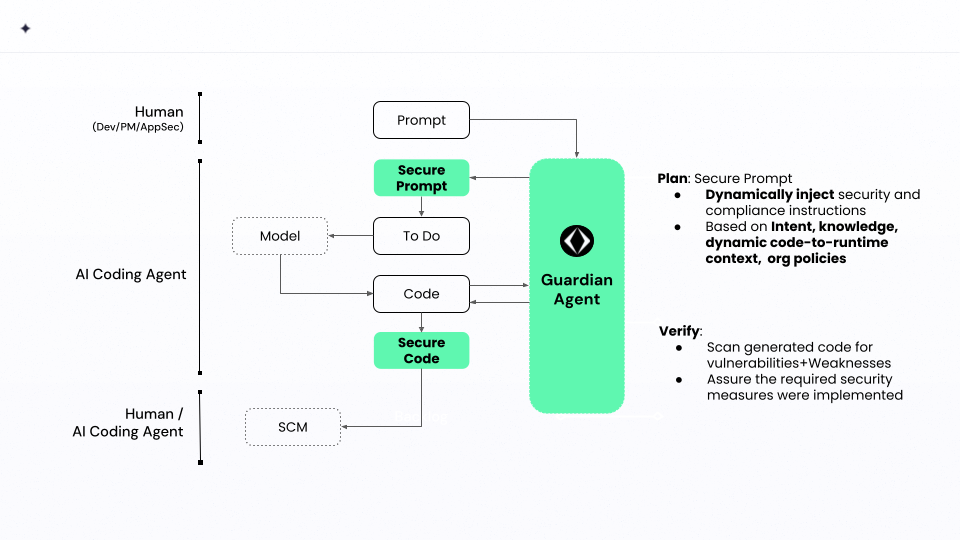
Apiiro Guardian Agent is an AI AppSec agent acting as an always-on, Principal Application Security Engineer – operating 24/7 across the SDLC. With Guardian, we are adding – for the first time – a Prevention layer for application security: proactively and contextually preventing risk before AI generates the code. Guardian achieves 3 main objectives:
Guardian Agent embeds security and compliance directly into how modern software is designed, developed, and delivered.
The centerpiece of Guardian Agent is the patent-pending Secure Prompt technology. While traditional tools scan code after it’s written, Secure Prompts guide AI to write secure code the first time.
| Scenario | Raw Developer Prompt (Without Guardian Agent) | Secure Prompt (With Guardian Agent) |
| New API endpoint | “Implement DELETE /risks/{id} API endpoint to delete a risk by its ID.” |
“Implement DELETE /risks/{id} API endpoint to delete a risk by its ID. – Examine <filepath:line> where the api/risk/filters/searchLocation endpoint implements Authorization — follow this exact pattern. – Apply Microsoft AspNetCore Authentication .NET (configured in <filepath:line>) and Authorization to ensure proper access control. – Implement input validation for the {id} parameter as defined in <filepath:line> to prevent IDOR and injection attacks. – Since this repository handles PII data and is internet-exposed, ensure no sensitive data is logged or exposed.” |
| Data access to user store | “Write a function to fetch user data from the database based on the ID parameter.” |
“Write a function to fetch user data from the database based on the ID parameter. – Use existing authentication and authorization patterns (Microsoft AspNetCore + WIF). – Ensure the session token is validated against the UserID. – Implement input validation for the ID parameter. – Use parameterized queries to prevent SQL injection. – Since the repository handles PII data, ensure GDPR-compliant data masking is applied.” |
| File upload feature | “Build a component to allow users to upload profile pictures to S3.” |
“Build a component to allow users to upload images and store them in S3. – Validate file type, size (max 5MB), and sanitize filenames. – Apply least-privilege access and default Private ACL on the S3 bucket. – Scan uploads for malware where possible. – If images contain PII, encrypt them using HashiCorp Vault before storage.” |
| External provider integration | “Create DataDog API integration.” |
“Create a DataDog integration using api_key and app_key headers. – Retrieve credentials securely from HashiCorp Vault — never hardcode. – Use the internal SecretManager class. – Apply outbound HTTP security hardening (TLS, timeouts, header stripping).” |
| Incremental UI functionality | “In pdf-service.ts, add a helper that captures a graph element as an image and saves it to PDF.” |
“Add a helper in pdf-service.ts that captures a graph HTMLElement and saves it to PDF. – Sanitize the fileName parameter following existing validation patterns. – Use approved libraries: html2canvas (ver XX) and jsPDF (ver YY). – Ensure error messages do not expose sensitive system details.” |
Guardian Agent is designed to leverage expertise accumulated through analysis of thousands of real-world scenarios from Fortune 1000 Apiiro customers. This allows the Agent to wield the deep knowledge and experience of a Principal Security Engineer, making it qualified to intervene on and secure prompts for all application security tasks across design and development: threat modeling, building secure and compliant code, detecting, triaging, and even fixing code risk.
By grounding the agent in the Apiiro Data Fabric – Software Graph and Risk Graph™ – Guardian Agent delivers specialized value across the entire development lifecycle:
| For Developers: Secure-by-Default coding | For AppSec: Automated Governance at scale |
| Secure coding: Instead of fixing bugs after they are committed, Guardian Agent ensures security is baked in before a single line of code is generated, effectively closing the gap between AI productivity and organizational risk. It contextually rewrites prompts in real-time, to govern and infuse AI coding agents with contextualized security expertise and controls, tailored to your specific organization. | Policy enforcement at the source: Define security requirements and threat models once, and have Guardian automatically inject them into every AI-driven coding session. |
| Contextual awareness: No more generic security advice. Guardian understands the intent of the code within the specific software architecture, eliminating noisy false positives. | The “Scale” button: One AppSec engineer can now oversee thousands of AI-generated commits, with Guardian handling the first layer of triage and remediation. |
| Frictionless fix: When a risk is identified, Guardian doesn’t just flag it – it provides the “Why” and the “How-to-Fix,” tailored to the specific application context. | Instant Visibility: Query your entire estate for emerging threats (like the Shai-Hulud attack) and deploy automated fixes across the organization in seconds. |
This isn’t just another layer of scanning. By shifting from reactive detection to proactive control, Guardian effectively closes the gap between productivity and risk. It empowers developers to move faster without looking over their shoulder, and it allows security teams to transition from manual ticket-pushing to high-level strategic governance.
Guardian Agent consolidates the essential AppSec pillars of ASPM, AST, SSCS, threat modeling, secure coding and more into a single agent. It has access to all the tools and capabilities required to perform these tasks – built in Apiiro, or integrated with any 3rd party security tool already in our customers’ environment.
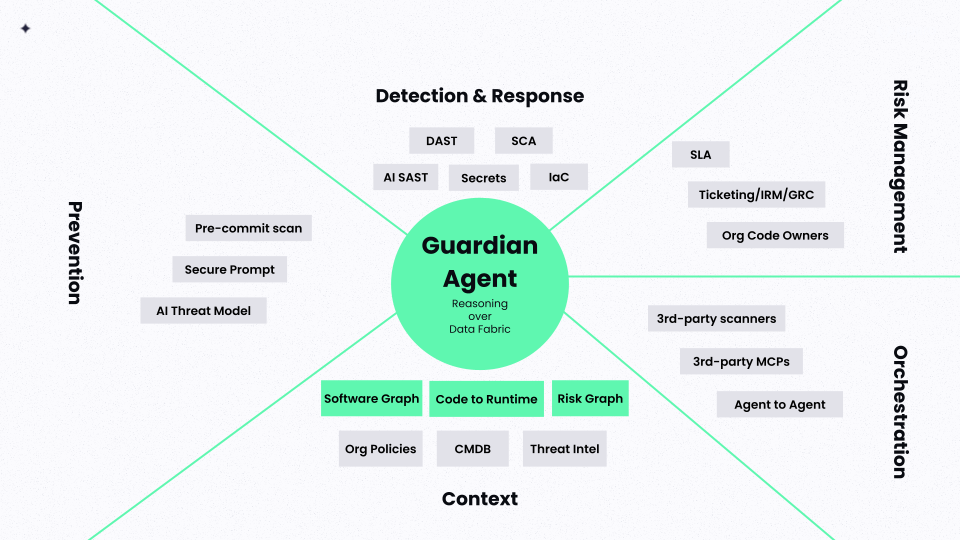
In order to achieve ASPM success criteria effectively, Guardian relies on a robust data foundation – enabling it to reason and act autonomously, with confidence. The Apiiro Data Fabric supplies that foundation:
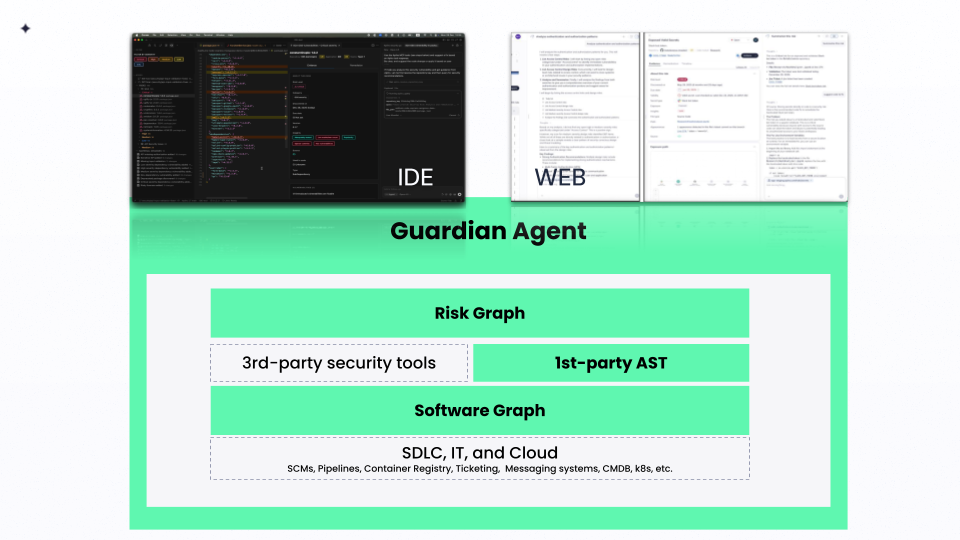
Guardian serves multiple personas – AppSec teams, developers and pentesters.
It is exposed via multiple parallel interfaces, meeting users where they are:
We worked closely with our design partners to test Guardian against the most complex security challenges. Here is how it reimagines the day-to-day work of engineering and security teams:
Guardian capabilities are constantly evolving, as it hones the skills of a Principal AppSec Engineer across the SDLC. Here is a glimpse of its current capabilities::
| Capability | SDLC Phase | What It Enables |
| Automated Threat Modeling | Design | Automatic threat modeling and generating contextual countermeasure recommendations per ticket, or per feature – based on the customer Software Graph inventory and risk policies. |
| Secure Prompt | Design | Prompts are transparently enriched with Software Graph inventory, risk policies, and runtime context before reaching the LLM and generating the code. |
| Software Graph | Design & Development | Ask anything about the software architecture, software inventory and code-to-runtime: e.g. where are APIs deployed? What is the framework for logging? What code module? Did someone develop a simpler API in this framework before? Is this API internet-exposed, and what security controls apply? |
| Risk Graph | Development | Ask anything about the risks in the existing code base: e.g. what are the most critical risks, how to fix them, what is the SLA to fix? Perform actions on risks: e.g. change severity, accept risk. |
| Inline code scan | Development | Detect new risks in your local changes and see what will block your PR: AI SAST, SCA, Secrets, IaC, etc. |
| AutoFix | Development | Contextual fixes for SAST, SCA, Secrets, and API security aligned with your software graph inventory, company risk policies and runtime context. |
| Incidents exposure | Governance | Understand your exposure over your entire applications portfolio to ongoing incidents (e.g. Shai-Hulud). |
| Repository / Code Module / Application / Team risk profile | Governance | Risk-based prioritization aligned with organizational frameworks. |
| Ownership identification | Governance | Quickly find responsible engineers per code resource (e.g. API, OSS, AI model, secrets) and/or risk for faster remediation. |
Guardian Agent marks the shift from intermittent, reactive scanning to continuous, proactive prevention. It eliminates the unnecessary tradeoff between security and speed by embedding a security-first mindset directly into AI-assisted development.
Guardian is the culmination of Apiiro’s approach to autonomous application security: AI needs a map – and fixes alone are no longer enough.
With Guardian Agent, prevention becomes the default – and secure, compliant software becomes the natural outcome.
A private preview of Guardian Agent is available today for all Apiiro customers. See it for yourself.

This site uses cookies to deliver services and to analyze traffic.